
The cell and gene therapy (CGT) field is actively exploring innovative pathways beyond viral vectors due to inherent safety concerns—such as genomic integration-related carcinogenicity risks and immunogenic complications—and commercial scalability challenges. mRNA technology, with its non-viral delivery characteristics, enables transient and controllable protein expression while avoiding DNA integration risks, positioning it as a strategic breakthrough for advancing CGT.
Focusing on these core needs, ENO Bio leverages its proprietary mRNA technology platform to drive progress in two cutting-edge areas: mRNA-based gene editing and mRNA-based cell therapies. Through dual-track iteration of delivery systems—including targeted LNPs—and its AI-enabled design platform, ENO Bio is building a comprehensive patent ecosystem covering mRNA gene editing and mRNA CAR-X technologies. This integrated approach offers safer and commercially viable CGT solutions for rare diseases, cancer immunotherapy, and regenerative medicine.
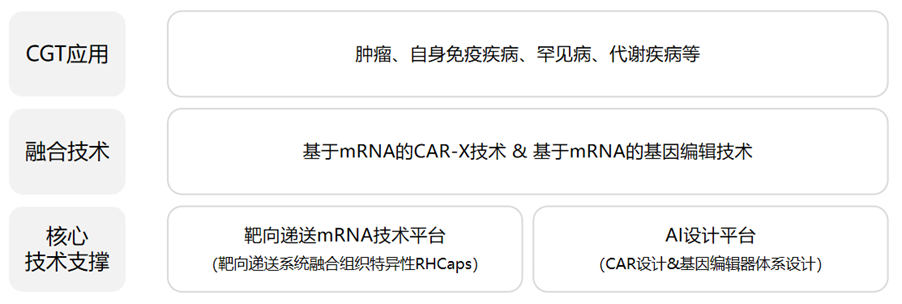
The development of gene-editing therapeutics requires addressing two core challenges: efficient targeted delivery and highly specific editing tools.
In the area of targeted delivery, as detailed in previous sections, ENO Bio has developed both a proprietary LNP delivery system based on novel cationic lipids and a proprietary ligand-mediated mRNA delivery system (non-LNP). These platforms enable targeted delivery for mRNA vaccines and therapeutics to various tissues and organs—including the liver, spleen, central nervous system, tumors, bone joints, heart, and skin—supporting both systemic and localized administration to meet a broad range of clinical application needs.
Regarding gene editing tools, ENO Bio has successfully validated Cas9-based editors using its LNP-mRNA delivery system. Building on this foundation, the company is also advancing novel, proprietary gene-editing systems to expand the scope and precision of mRNA-mediated therapeutic genome modification.

Regarding targeted delivery, early approaches primarily relied on viral vectors. However, progress has been significantly hampered by the substantial safety risks associated with these methods. A prominent example is the EDIT-101 program, an AAV-based gene therapy developed by Editas Medicine and Allergan, which was terminated due to suboptimal clinical performance. While numerous delivery platforms have been reported, the most mature non-viral approach currently is based on mRNA-LNP. mRNA offers a superior safety profile for two key reasons: firstly, mRNA carries no risk of genomic integration; secondly, the transient expression of the gene editor from mRNA, compared to the prolonged expression from viral delivery methods, substantially reduces the risks of off-target editing and chromosomal structural variations.
Building on this foundation, ENO Bio has developed a suite of targeted delivery systems. Beyond a highly specific liver-targeting formulation, the company has also established platforms for delivery to the spleen, central nervous system, tumors, bone joints, heart, and skin. In the context of liver-targeted gene editing, ENO Bio's proprietary RHT19 LNP, used to deliver editor mRNA and sgRNA, demonstrated significantly higher editing efficiency (66.93%) compared to formulations using the benchmark ionizable lipid ALC-0315 (52.85%). With the continued advancement and broader application of ENO Bio's delivery systems, gene editing targeting a wider range of tissues and cells is poised to become a reality.
mRNA-Based Cell Therapy Technology
Engineered cells have demonstrated significant potential in disease treatment. Since the 1990s, viral vector-mediated genetic engineering has played a major role in this field. However, in recent years, clinical applications of viral-based products have revealed a series of limitations that hinder the advancement of cell therapies. These concerns are primarily safety-related, including the risk of viral vector integration into the genome potentially leading to carcinogenicity, immune-related complications, and unforeseen disease progression. Additionally, viral vectors can cause adverse effects such as immunosuppression, cytokine release syndrome (CRS), and neurotoxicity.
Advances in mRNA technology now offer a new strategic solution for cell therapy development. Using mRNA to engineer cells eliminates the safety risks associated with DNA integration into the host genome. Furthermore, with the emergence of efficient mRNA delivery systems, synthetic mRNA can be directly used for ex vivoand in vivocell engineering and reprogramming, offering clear advantages in safety and cost over viral vectors.
In recent years, the integration of mRNA technology with cell engineering has become an important research area, creating new opportunities for precision and personalized medicine. Key applications focus on two main approaches: using mRNA for ex vivoand in vivocell engineering and reprogramming. This includes creating CAR-T cells, CAR-NK cells, and potentially CAR-macrophages (CAR-Ms) by delivering mRNA-encoded chimeric antigen receptor (CAR) or T-cell receptor (TCR) proteins, representing a new direction for cellular immunotherapy.
Leveraging AI-assisted CAR design, mRNA sequence optimization, and the application of tissue-specific RHCaps, ENO Bio has developed innovative solutions spanning oncology, autoimmune diseases, metabolic disorders, and cardiovascular and cerebrovascular diseases. With deep technical expertise, continuous innovation, and extensive project experience, ENO Bio supports partners in developing customized mRNA CAR-X products that address diverse therapeutic needs with significant clinical value and improved accessibility, thereby advancing the field and commercial translation of mRNA-based cell therapies.